
Cybersecurity for regulated and safety‑critical industries
Penetration testing, threat modeling, and security advisory for safety-critical industries and medical device manufacturers, built by people who helped define regulatory expectations.
Medical device cybersecurity
Cybersecurity testing designed by people who helped write the FDA cybersecurity guidance. From penetration testing and threat modeling to submission-ready documentation – we handle the cybersecurity so you can focus on the device.
Learn moreCybersecurity testing
Web, mobile, cloud, and network penetration testing to uncover weaknesses before adversaries do. Our experts simulate real-world threats with findings prioritized by your organization's defined risks.
Learn moreCybersecurity advisory & vCISO
Strategic guidance to build and manage a security program that works. From virtual CISO services to compliance alignment and risk management, we help you integrate security into the way your business already operates.
Learn moreOur methodology aligns with the standards and frameworks that regulators and notified bodies expect:
Not sure what you need?
Talk with a Stratigos security expert to design the right solution for your product, team, and timeline.
Five reasons manufacturers choose us for consequential submissions
We helped write the rules
Our founder helped shape regulatory expectations for cybersecurity, in medical devices, automotive, home IoT, and other areas, working with US and international regulatory bodies through I Am The Cavalry since 2013. For instance, he built a medical device cybersecurity test lab recognized by a sitting FDA commissioner as a model for what good testing looks like, wrote A Hippocratic Oath for Connected Medical Devices, and served as Entrepreneur in Residence there helping to define safe and secure pathways to market. Our team brings the same depth: collectively, hundreds of cybersecurity assessments across safety-critical systems, like medical devices, the electrical grid, and water facilities. Our testing methodology, report structure, and regulatory support are calibrated for real-world hazards, written in language that engineering and quality professionals can understand, and that meet regulatory expectations – because we helped define what that looks like.
A track record you can rely on
We have supported medical device regulatory submissions from Class I through Class III, through 510(k), PMA, De Novo, and IDE pathways, including novel devices and first-to-market submissions where regulatory scrutiny is highest. Across automated insulin delivery, surgical robotics, bioelectronic medicine, and diagnostics, our testing holds up under the level of review your device will face.
Your full cybersecurity testing partner
From scoping and threat modeling through testing, reporting, and remediation support, a single Stratigos team carries your engagement from first scope to final report and through your regulatory submission. We produce the testing evidence and documentation your submission needs and we stay with you through review.
Expert guidance throughout the process
From our first conversation until your product hits the market, Stratigos provides guidance and support to demystify cybersecurity concepts (without trying to make you an expert), tell you what we've seen work (without prescribing your path), and support you when questions arise (rather than drop a report and run).
Experience tailored to your device
Expert-driven testing within your unique context that goes beyond what automated scanners produce or standards can anticipate. Stratigos covers what others can't, like touch interfaces, physical tamper resilience, and custom wireless protocols. Every finding is contextualized for clinical and regulatory relevance, producing reports that engineers, regulatory teams, and reviewers can work with directly.
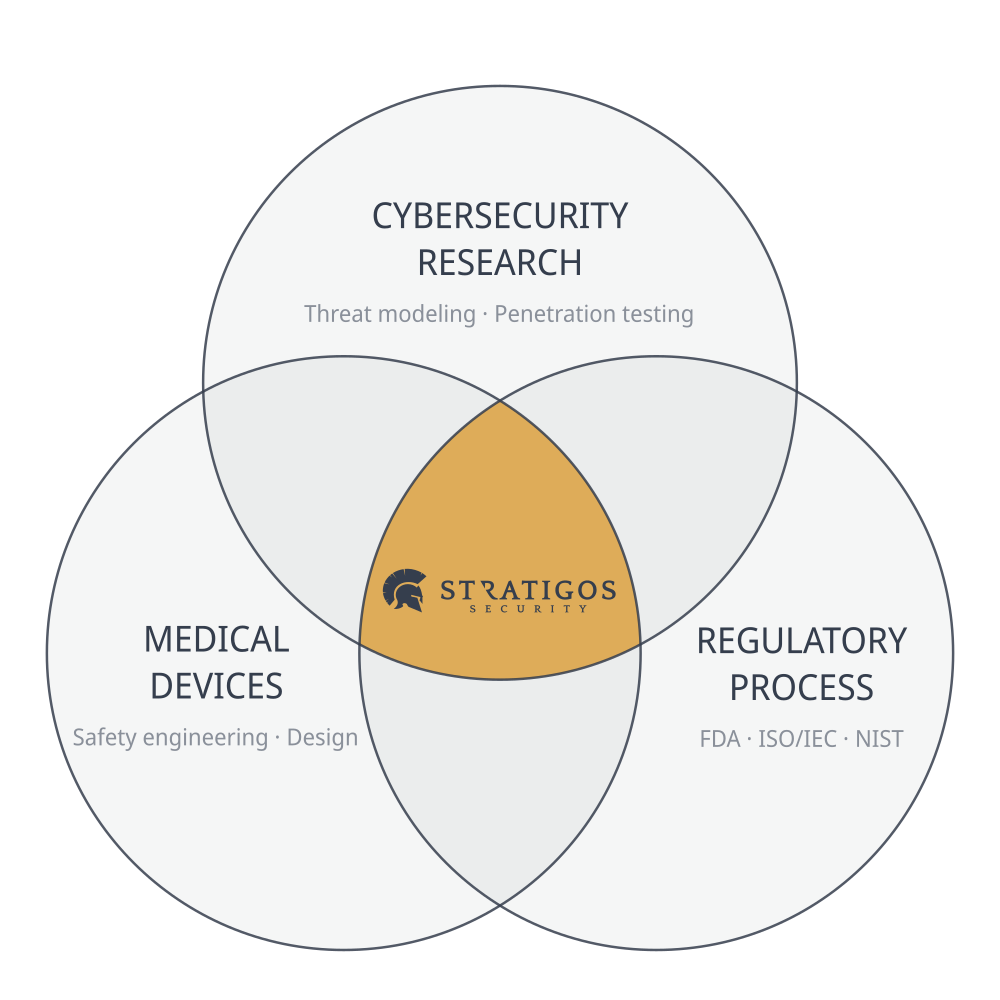
They were the only one who understood the cybersecurity side, the medical device and safety side, and the regulatory side. They knew what we needed to do and how to get it done.Director of Software Engineering, MedTech Startup
Recent writing and appearances
The random number was 4 – what the eMudhra CA incident means for connected devices
A Certificate Authority generated cryptographic keys from tiny random numbers – one of them was just 4. Browsers and phones are fixed; medical devices, cars, and other IoT devices are likely exposed until updated.
Sep 15, 2026 WebinarValidating Medical Device Cybersecurity Through Penetration Testing
MDIC panel on pen testing best practices for FDA submissions. With Justin Post (FDA CDRH), Jessica Wilkerson (Roche, formerly FDA), and Chris Reed (Medtronic).
Sep 10, 2026 ArticleWhich FDA cybersecurity guidance applies to my submission?
Four FDA premarket cybersecurity guidances share almost the same name. Which one is current, what each superseded, and how to tell which applies to your submission.
Ready to secure your device and accelerate your path to market?
Let's talk about your project before your submission timeline gets tight. The cost of a delay can far exceed the cost of doing testing right the first time.